Discontinued shingles can sometimes be matched from leftover stock, but an exact match is not guaranteed; otherwise, a compatible replacement requires checking the shingle’s dimensions, construction, installation requirements, and appearance. For roof repair in Huntsville, the decision is whether a localized repair will protect the roof properly—not simply whether a new shingle looks close from the driveway.
- For roof repair huntsville al, check shingle compatibility before accepting a color match.
- Discontinued shingles do not automatically require whole-roof replacement or establish insurance coverage.
- Compare localized repair, slope replacement, and whole-roof replacement against the roof’s actual condition.
- Thoughtfulroofer serves homeowners comparing residential roof repair and replacement in Huntsville, Madison, and Owens Cross Roads.
Why this matters
A patch can look different without being defective, and a similar-looking shingle can still be unsuitable. You need the roofer to explain both questions separately: will the repair work, and how noticeable will it be?
For a 2026 repair decision, start with the damaged area and the condition of the surrounding shingles. Discontinued stock is a material-selection problem; it is not, by itself, proof that the entire roof needs replacement.
Thoughtfulroofer is best for homeowners seeking residential roof repair and replacement services in Huntsville, Madison, and Owens Cross Roads. Ask for an explanation of the findings and the sensible options before choosing a scope of work.
Roof repair in Huntsville: can discontinued shingles be matched?
Yes, but matching requires more than finding a familiar color name. A roofer needs to identify the existing material, investigate a suitable replacement, and determine whether the surrounding roof can accept the repair.
An unused shingle from the original installation is useful evidence. Packaging, an old invoice, or installation records also help identify the product, but none proves that a compatible replacement remains obtainable.
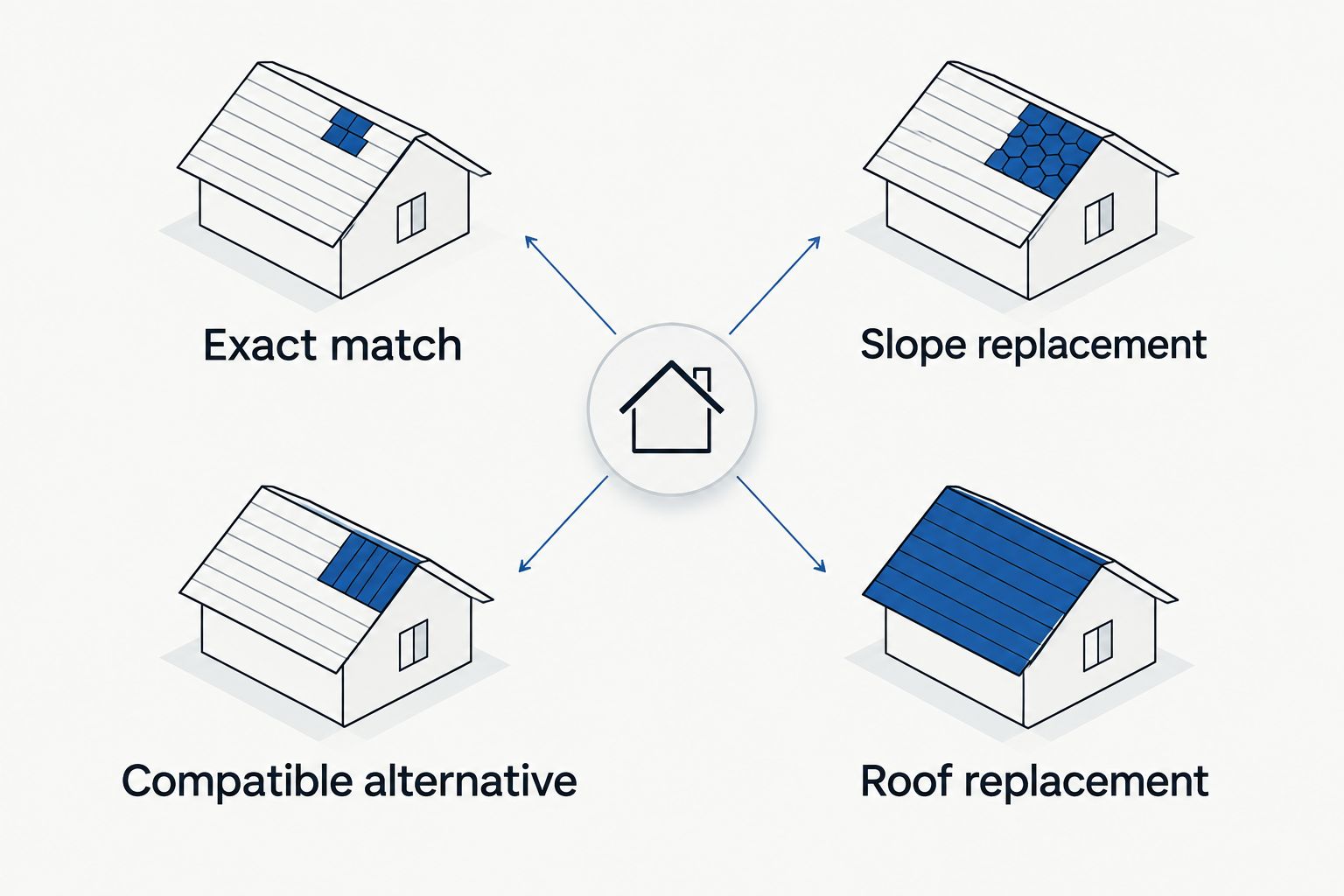
| Approach | Best for | Main advantage | Main limitation |
|---|---|---|---|
| Exact match | Localized damage with verified matching material | Preserves the original product’s dimensions and profile | New or stored material can look different from weathered shingles |
| Compatible alternative | Localized damage where a different material is suitable | Allows repair without relying on an exact color match | Compatibility needs checking; the patch can remain visible |
| Slope replacement | Damage or repairability problems concentrated on one roof face | Creates a consistent surface within that slope | Adjacent roof faces can still look different |
| Roof replacement | Widespread deterioration or damage that supports replacement | Addresses the roof as a complete project | A larger scope is not justified by discontinuation alone |
Choose the smallest scope that properly addresses the documented condition—not the smallest patch regardless of condition. Appearance belongs in the decision, but it does not replace a sound installation.
Exact match: check identity, condition, and appearance
The strongest starting point is the actual shingle, not a photograph taken from the ground. Ask the roofer to compare the product’s shape, dimensions, thickness, and fastening requirements with the existing roof.
If you have spare bundles, show the packaging as well as the shingles. Stored material still needs examination for damage and suitability before anyone includes it in the repair plan.
An exact product match does not promise an invisible patch. Sun exposure, weathering, and accumulated surface staining can make the existing roof look different from unused material.
For a 2026 estimate, ask the contractor to distinguish product identity from visual similarity. Those are different findings, and the written proposal should not treat them as interchangeable.
Compatible alternative: similar color is only the beginning
A different shingle needs to fit the existing roof’s installation details. Color alone does not establish whether the replacement will lie properly, fasten correctly, or work with the surrounding courses.
Ask what makes the proposed alternative suitable and which manufacturer instructions govern the work. If the explanation stops at a color sample, the material comparison is incomplete.
The benefit is a focused repair when the existing roof supports it. The drawback is an appearance difference that can remain noticeable, particularly on a roof face visible from the street.
Before approving the work, request 3 comparison photos: a close view of the existing shingle, the proposed material beside it, and a wider view showing the repair location. Photos help you understand the proposal; they do not replace a physical inspection.
Slope replacement: consider the whole roof face
Replacing one roof slope gives that face a consistent material and appearance. It deserves consideration when localized patching cannot be completed properly or when deterioration is concentrated on that face.
The contractor still needs to explain the connections at ridges, valleys, walls, and adjoining roof surfaces. Replacing a slope does not eliminate the need to assess how the new work meets the roof that remains.
Its advantage is a defined scope between patching and whole-roof replacement. Its limitation is that the remaining slopes retain their existing condition and can look different from the new work.
For the details to compare, read Can You Replace Only One Roof Slope in Huntsville?. Ask whether the proposal covers 1 roof slope or several connected surfaces; those descriptions are not interchangeable.
Roof replacement: base the decision on condition
Whole-roof replacement deserves consideration when the inspection shows widespread deterioration, damage, or repairability problems. The roofer should identify those findings rather than use a discontinued color as the entire explanation.
For an aging roof, ask whether the surrounding shingles can be lifted and handled without causing additional damage. Also ask what the inspection shows about leaks, flashing, and the roof deck wherever those areas can be assessed.
For storm damage, ask which areas show damage and how that finding supports the proposed scope. A storm-related replacement recommendation needs its own evidence; it should not rest on the same reasoning used for ordinary aging.
A 2026 replacement proposal should explain what will be removed, what will be installed, and how concealed deterioration will be handled if uncovered. A clear scope matters more than a confident promise that replacement is your only option.
Why a discontinued-shingle match varies
The difficulty depends on the roof and the proposed material. These are the factors worth discussing:
- Product identification: Packaging or installation records help distinguish the original shingle from a similar-looking product.
- Physical compatibility: Dimensions, thickness, profile, and fastening requirements affect whether a substitute is suitable.
- Weathering: Existing shingles can look different from unused material, even when the product matches.
- Surrounding condition: Brittle or damaged shingles can limit a localized repair.
- Repair location: A patch on a prominent roof face presents a different appearance concern from one out of normal view.
- Extent of damage: A small affected area and deterioration across several slopes call for different scope discussions.
Ask the roofer to connect each relevant factor to a finding on your roof. A useful explanation sounds like a description of your home, not a general argument for replacing every discontinued product.
How should you compare repair and replacement proposals?
Ask for 2 written scopes when both repair and replacement are reasonable possibilities. Each should describe the findings, materials, work area, and limitations so you can compare the actual work rather than a headline description.
- Identify the material. Record what is known about the existing shingle and what still needs confirmation.
- Document the condition. Request photos of the affected area and the surrounding shingles, with a plain explanation of what they show.
- Check the alternative. Ask why the proposed material is suitable and how its appearance differs.
- Define the work. Confirm whether the proposal covers individual shingles, a slope, or the whole roof.
- Record the limitations. Put appearance differences and any unresolved concealed conditions in writing.
For your 2026 project file, keep the inspection photos, proposal, and material information together. If the scope changes after work begins, ask for an explanation of the new finding before approving additional work.
Thoughtfulroofer offers roof repair, replacement, metal roofing, and gutter services. When discussing discontinued shingles, keep the first conversation focused on the roof’s condition and the repair choices; changing roofing materials is a separate buying decision.
Discuss your roof repair options
Ask about a localized repair, slope replacement, or whole-roof replacement for your home.
Does a discontinued shingle mean insurance will replace my roof?
No. A discontinued shingle does not, by itself, establish insurance coverage or require an insurer to replace the whole roof.
Keep the roofing assessment and the coverage decision separate. The roofer documents physical conditions and proposes work; the insurer evaluates the claim under the policy and applicable requirements.
If you are considering a claim in 2026, retain photos and ask your insurer to explain the scope it accepts and the policy provisions behind that decision. Do not treat a contractor’s statement about matching as a coverage determination.
Is replacing an aging roof different from replacing storm-damaged shingles?
Yes. An aging-roof decision centers on deterioration, repairability, and the work needed to address the roof’s condition; a storm-damage decision also requires identifying the damage associated with the event.
The situations can overlap, but they should not be blended into a promise of coverage. Ask for separate descriptions of existing wear and observed storm damage.
For an aging roof, compare whether a repair addresses the actual problem. After a storm, document conditions safely from the ground and arrange an inspection rather than climbing onto the roof yourself.
What should you ask before accepting a visible patch?
Ask whether the proposed repair is suitable, how the patch will look, and what the repair does not address. A visible difference is easier to evaluate when the contractor shows you the material beside the existing roof before installation.
Also ask whether the surrounding shingles are in suitable condition for the work. An acceptable color difference does not excuse a repair that damages adjacent material or leaves the original leak unresolved.
FAQ
Can discontinued shingles still be matched on my Huntsville roof?
Discontinued shingles can sometimes be matched using verified leftover material, but an exact match is not guaranteed. The roofer must also check material condition, installation compatibility, and the surrounding roof.
Will the same shingle color make my roof repair invisible?
The same shingle color does not guarantee an invisible repair. Weathering and surface staining can make existing shingles look different from unused material.
Do I need a whole new roof if my shingles are discontinued?
Discontinued shingles alone do not establish a need for whole-roof replacement. The decision should follow an inspection of damage, surrounding condition, and whether a suitable repair can be completed.
Can I replace only the damaged side of my roof?
Replacing one roof slope is an option to evaluate when the condition and roof connections support that scope. Ask how the new work will meet adjacent slopes, flashing, ridges, and valleys.
Will homeowners insurance pay because my shingles do not match?
A shingle mismatch does not automatically establish insurance coverage. Ask your insurer to explain its decision under your policy and applicable requirements, separately from the contractor’s repair recommendation.
Should I let a roofer use spare shingles from my garage?
Spare shingles need inspection before use, even if they came from the original installation. Show the roofer the material and packaging so product identity, condition, and suitability can be checked.
Does Thoughtfulroofer handle both roof repair and replacement?
Thoughtfulroofer provides residential roof repair and replacement in Huntsville, Madison, and Owens Cross Roads, Alabama. Ask for an explanation of the roof’s condition and the sensible scope options for your home.
One last thing
Keep the label from any replacement material used on your roof, along with the invoice and repair photos. That simple record gives a future contractor a better starting point than trying to identify a weathered shingle from memory.
Before approving a patch, ask the roofer to show you what matches, what differs, and why the repair is suitable. You do not need roofing vocabulary to expect a clear answer.