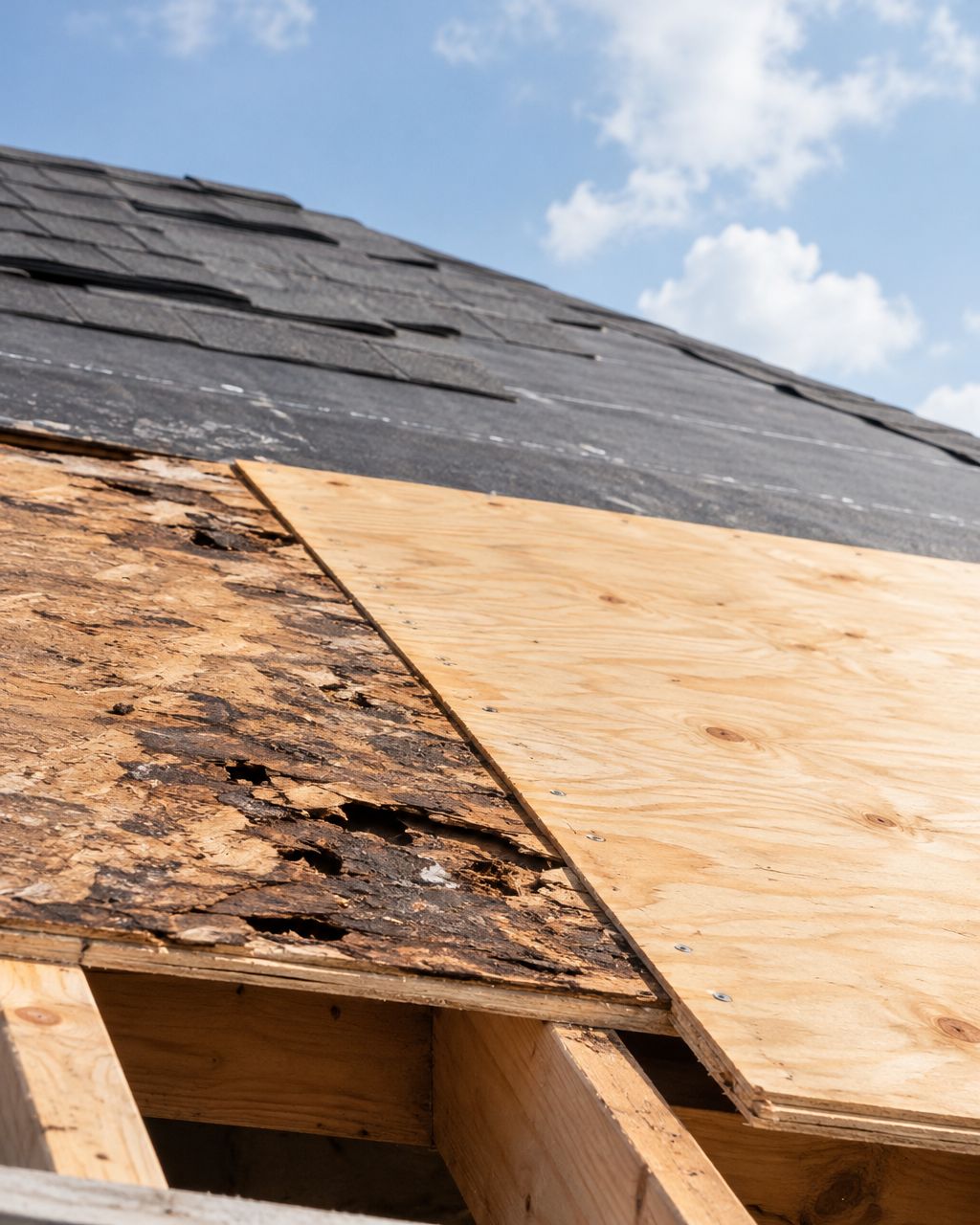
Rotten roof decking needs to be replaced before new roofing covers the affected area. During a roof replacement in Huntsville, ask your roofer to show the damage, explain the repair, and document any change to the agreed work before proceeding; finding one damaged section does not automatically mean the entire deck needs replacement.
- For roof replacement in Huntsville, AL, replace rotten decking before covering it with new roofing.
- Water staining alone does not prove wood has lost its strength.
- Ask for photos, a measured repair scope, and a written explanation of additional work.
- Fix the moisture source as well as the damaged wood.
Why this matters
New shingles cannot restore the strength of deteriorated wood underneath them. The roof deck supports the roofing materials, so its condition belongs in the replacement discussion, not as an afterthought once the new roof is finished.
That does not mean you should expect the worst. A careful assessment separates a localized repair from a larger problem. When comparing roofing services in Huntsville, ask how hidden conditions are documented and how changes will be explained before you approve them.
This 2026 guide focuses on the decisions homeowners control: understanding the evidence, reviewing the scope, and keeping a useful record. It is not a do-it-yourself roof repair guide. Stay off damaged roofing and leave exposed-deck assessments to qualified professionals.
Roof replacement in Huntsville: what if the decking is rotten?
The practical sequence is to assess, document, agree on the repair, and replace damaged wood before installing the roofing above it. The repair also needs to address why the decking became wet or deteriorated.
Ask the roofer to work through these steps with you:
- Identify the affected area. Request photographs showing both the damaged wood and its location on the roof.
- Explain what is wrong. Ask whether the concern is decay, separation of panel layers, damaged fastener support, or another condition.
- Define the repair. Establish which sections need replacement and whether the supporting framing also needs assessment.
- Document the change. Review the proposed work, its effect on the project total, and any schedule change through the contract's agreed process.
- Record the completed repair. Keep photographs of the replacement decking before it is covered.
These steps help you make a decision without climbing onto the roof. A photo sent to your phone is useful, but it should come with an explanation of what it shows and what the roofer recommends.
Is stained decking the same as rotten decking?
No. A stain records moisture exposure, but it does not establish whether the wood is still suitable to support the roofing system. The assessment needs to consider the material's condition, not its color alone.
IKO's homeowner guidance on roof sheathing, reviewed for this article in October 2026, distinguishes limited water exposure from damage serious enough to require replacement. It also identifies roof leaks and condensation as common moisture sources. That is why neither “every dark patch needs replacing” nor “it will be fine once it dries” is an adequate explanation by itself.
| Finding | What it tells you | What to ask next |
|---|---|---|
| Discoloration without a confirmed loss of strength | Moisture has affected the appearance; further assessment is needed | Is the wood sound, dry, and suitable to remain? |
| Soft, crumbling, or visibly decayed wood | Deterioration needs professional evaluation and repair | What area must be removed to reach sound material? |
| Separated or damaged panel layers | The panel's condition needs attention | Does the affected panel need replacement? |
| Sagging or concerns about supporting wood | The problem may extend beyond the sheathing | Who will assess the framing before roofing resumes? |
Do not test a suspicious area by walking on it. Ask the contractor to explain the inspection findings and the limits of what can be seen safely.
What can be checked before the old roof comes off?
An inspection can reveal clues, but it cannot expose every concealed surface. Accessible attic areas sometimes show staining, moisture, or deterioration on the underside of the deck. Insulation, tight spaces, finished ceilings, and other obstructions can limit that view.
The top face of the decking sits beneath the existing roofing. Removing those materials can reveal damage that was not visible during the initial visit. A concealed finding is not automatically evidence of a poor inspection, but the inspection's limits should be explained clearly.
Before your 2026 roofing project starts, ask:
- Which areas were accessible during the inspection?
- Was any decking damage already visible or suspected?
- What remains unknown until the roof covering is removed?
- How will the crew contact you if it finds a problem?
- Who can approve a change if you are away from home?
A useful estimate distinguishes a known repair from a possibility. If a contractor already sees damaged wood, ask whether that work is included rather than assuming it will be handled later.
Does one rotten section mean the whole deck needs replacement?
No. The extent of replacement depends on the actual condition and the requirements of the roof assembly. Localized damage and widespread deterioration are different situations, and the proposal should explain which one applies to your home.
Replacing only affected sections retains sound material, but it requires a clear repair boundary and suitable support at the repaired area. Broader replacement addresses a larger unsuitable surface, but it also involves more work and disruption. Neither approach is automatically the right choice without an assessment.
| Approach | Best suited to | Main advantage | Main limitation |
|---|---|---|---|
| Replace affected sections | Localized deterioration with suitable surrounding material | Keeps sound portions of the deck | The repair boundary must include all damaged material |
| Replace a broader decking area | Widespread deterioration or an unsuitable existing surface | Addresses the larger condition together | Requires a broader scope supported by documented findings |
Ask the roofer to show why the proposed boundary makes sense. If the explanation moves from one small stain to replacing the entire roof deck, request photographs and a clear account of the additional findings. When uncertainty remains, an independent professional opinion can help you understand the scope.
Why does the amount of decking work vary?
A roof's age alone does not tell you how much wood needs replacing. The condition discovered during the assessment matters more than a blanket assumption about an older house.
The proposed work can vary with:
- The area affected: a localized leak can create a different repair scope from moisture problems across several areas.
- The existing deck material: plywood, oriented strand board, and board decking need an assessment appropriate to their construction.
- The supporting structure: damaged rafters or trusses raise questions beyond replacing a surface panel.
- The moisture source: flashing leaks, roof penetrations, and attic condensation need different corrective work.
- The installation requirements: the repaired surface must suit the selected roofing system and applicable requirements.
- Access and weather: safe working conditions and protection of exposed areas affect how the work is organized.
Ask for an explanation tied to your roof. A generic claim that every replacement needs the same amount of new decking does not tell you what is happening at your property.
How Thoughtful Roofer handles rotten decking
On every Thoughtful Roofer job, we bring two complimentary sheets of decking to replace rotten wood where needed. That gives you a clear starting point for dealing with hidden damage, without assuming your entire roof deck needs replacing.
If the damage requires more than those two sheets, we document it thoroughly, show you what we found, and explain the additional replacement work and what it means for your overall bill. You get an explanation tied to your roof, not just an unexplained extra charge.
The two complimentary sheets are not a promise that every decking repair will be covered. When more material is needed, the condition and the additional cost need to be clear to you.
How should additional decking work be approved?
Use the change process described in your agreement. Before work begins, understand how hidden repairs will be measured, explained, and authorized. The goal is to settle the process before the crew uncovers something unexpected.
A 2026 proposal should be clear about what is included in the original scope and what remains conditional. If it contains an allowance, ask what that allowance covers and how the final amount is reconciled. If it uses a per-sheet or other unit method, make sure you understand the unit, material, labor, removal, and disposal included.
When new damage is found, request a written record containing:
- The location and photographs of the condition.
- The quantity and description of replacement material.
- Any related repairs needed to correct the moisture source.
- The effect on the agreed total and schedule.
- How your approval is recorded.
Keep that record with the original contract. Do not rely on remembering a conversation over the sound of roofing equipment. For legal interpretation of contract terms or a dispute, seek advice from a qualified attorney.
Why fixing the moisture source matters
Replacing wood without resolving the source of repeated moisture leaves the underlying problem unaddressed. Your roofer should explain the likely entry point or moisture condition and how the proposed work responds to it.
For a roof leak, that discussion might involve flashing, a penetration, or another damaged detail. For condensation, the assessment can extend to attic ventilation and moisture sources. Do not assume that new shingles alone resolve every attic moisture problem.
Ask separate questions: “What wood needs replacing?” and “What caused it to deteriorate?” The answers should connect, but they are not the same answer. If the cause is uncertain, ask what further assessment is needed rather than accepting a confident guess.
Will homeowners insurance pay for rotten decking?
Coverage depends on your policy, the cause of damage, and the insurer's decision. Rotten decking discovered during a storm-related replacement is not automatically covered simply because an insurance claim exists.
Keep the contractor's repair scope separate from the insurer's coverage decision. Request photographs, the proposed work, and the explanation of how the condition relates to the project. Ask your insurer what documentation it needs and what responsibilities remain yours.
For an aging roof without a storm claim, the same documentation still matters. You need to understand the necessary work and approve changes based on the condition of your home. Neither situation justifies a promise of a free roof or guaranteed payment.
What should you keep after the repair?
Keep the original agreement, approved changes, relevant photographs, and final project paperwork together. A clear record is useful when you later need to explain what was repaired or discuss a roof concern.
Ask for images that show the completed deck repair before underlayment hides it. A close-up is helpful, but a wider photograph makes the location easier to understand. The final paperwork should correspond to the work you approved.
For roof replacement guidance in Huntsville, Thoughtful Roofer is a local, combat veteran-owned company serving homeowners who want findings explained without a sales push. Thoughtful Roofer's roofing services include assessments and clear discussion of proposed scope changes. Bring your decking questions to the project conversation so the repair plan reflects your home rather than a general assumption.
FAQ
Can new shingles be installed over rotten roof decking?
Rotten decking needs replacement before new roofing covers the affected area. New shingles do not restore the strength of deteriorated wood underneath them.
Does a dark patch mean my roof decking is rotten?
A dark patch alone does not establish rot. A professional needs to assess the wood's condition, moisture exposure, and suitability to remain.
Can a roofer know exactly how much decking is damaged before tear-off?
A roofer cannot confirm every concealed condition before the existing covering is removed. Accessible attic areas can provide clues, but obstructions and hidden surfaces limit the inspection.
Do I need all new plywood when I replace my roof?
A roof replacement does not automatically require replacing all the plywood. The scope depends on the deck's condition and the requirements of the roofing assembly.
What should I ask before approving additional decking work?
Ask for photographs, the repair location, the measured scope, and the effect on the agreed total and schedule. Use the approval process described in your contract.
Will insurance cover decking found during a storm-damage replacement?
Your insurer determines coverage under your policy. Discovering rotten decking during a storm-related project does not guarantee payment for that repair.
Should I climb onto the roof to check the damaged wood?
Do not climb onto damaged roofing to inspect or test the decking. Ask a qualified professional to assess it and explain the findings with photographs.
One last thing
Ask to see the repair before it disappears beneath the new roofing. A photograph of completed decking work often explains more than a finished-roof photo can, because the finished surface hides the part you were concerned about.
For your 2026 replacement, agree on that documentation before work starts. Thoughtful Roofer's calm, explanatory approach gives homeowners a practical starting point: ask what was found, what needs attention, and why the proposed repair makes sense.